The first three seconds of a mobile game ad often decide whether the user keeps watching or moves on. This is especially true in fast-scrolling environments where attention is limited and the user has no obligation to care about the product.
A strong opening does not need to explain the whole game. It needs to create enough immediate curiosity for the user to stay. The challenge is to make that curiosity relevant, so the ad attracts players who are likely to enjoy the actual game.
Key Points
- The opening should show action immediately.
- The user needs to understand the situation quickly.
- Visual clarity matters more than visual complexity.
- Hooks should match the real product experience.
- Clickability should support user quality, not only volume.
Show the Moment, Not the Setup
Many weak ads spend too much time setting the scene. They show logos, menus, slow camera moves, or abstract mood before the user understands why the game is interesting. In mobile UA, that is usually too slow.
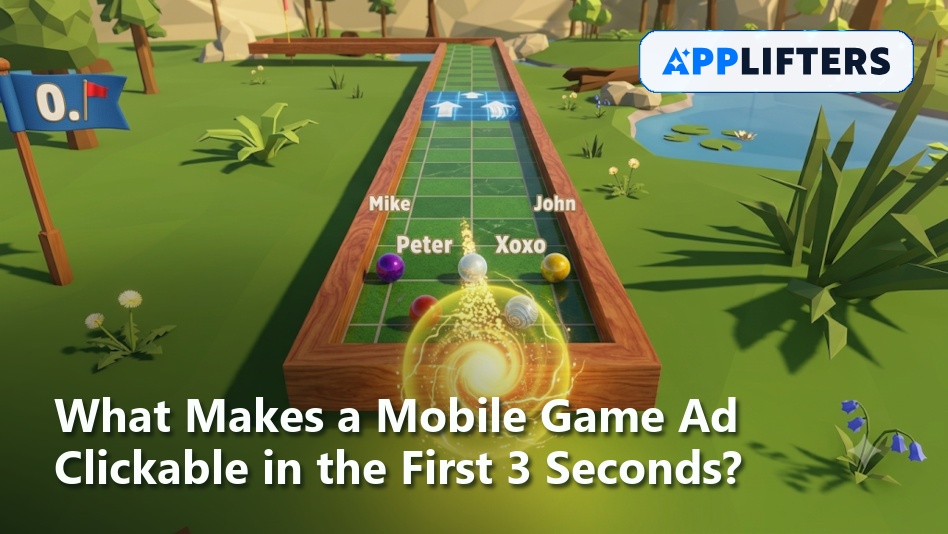
The ad should start close to the action. Show the puzzle about to fail, the enemy approaching, the reward waiting, the upgrade happening, the choice being made, or the player about to win or lose.
The user should not need to wait for the interesting part. The interesting part should be the first thing they see.
Create a Clear Reason to Watch
A good hook creates an open question. Will the player solve it? Will the character survive? Which choice is better? What happens after the upgrade? Can the user beat the challenge?
This question does not need to be complicated. In fact, simple questions often work best because they are easy to process on a small screen. The user should understand the stakes in one glance.
If the hook requires explanation, it is probably too slow for the first three seconds.
Make the Screen Easy to Read
Clickability depends heavily on clarity. Small UI elements, crowded scenes, dark contrast, unclear motion, and excessive text can weaken even a good idea. The user may skip because they do not understand what they are seeing.
Strong mobile game ads are readable without sound and without full attention. The key object, action, threat, or reward should be visually obvious. Text overlays should support the idea, not compete with it.
The first frame should answer: where should the user look?
Use Emotion, Not Only Mechanics
Gameplay mechanics matter, but emotions drive attention. A user may respond to failure, relief, satisfaction, tension, surprise, competition, progress, or humor. The same mechanic can be framed through different emotions, and each frame may attract a different audience.
For example, a puzzle game can open with a mistake, a near-perfect solution, a timed challenge, or a satisfying completion. The mechanic may be similar, but the emotional hook changes the user’s reason to watch.
Creative testing should explore these emotional angles, not only visual edits.
Keep the Promise Honest
The first three seconds should be clickable, but they should also qualify the user. If the ad promises an experience that the game does not deliver, the campaign may generate installs but hurt retention and long-term value.
The best hooks exaggerate clarity, not truth. They make the strongest part of the game easier to understand, but they do not sell a completely different product.
This balance is what separates useful attention from empty attention.
Why Work With AppLifters on Mobile Game Hooks
Strong hooks need creative instinct, but they also need performance feedback. AppLifters can help publishers test opening moments through playable and video creative production, then use UA Intelligence to understand which hooks attract valuable users rather than only short attention.
This is important because the first three seconds affect both campaign efficiency and audience quality. Combining Playables, BI, and UA lets the team test hooks, read downstream behavior, and scale the concepts that match the real game experience.
If you want to build hooks that convert and qualify players, contact AppLifters and book a demo.
Final Takeaway
A clickable mobile game ad starts with immediate action, clear stakes, strong visual readability, and an honest promise. The first three seconds should make the user understand why the game is worth another moment of attention.
Great hooks do more than stop the scroll. They attract the right players into the right product experience.